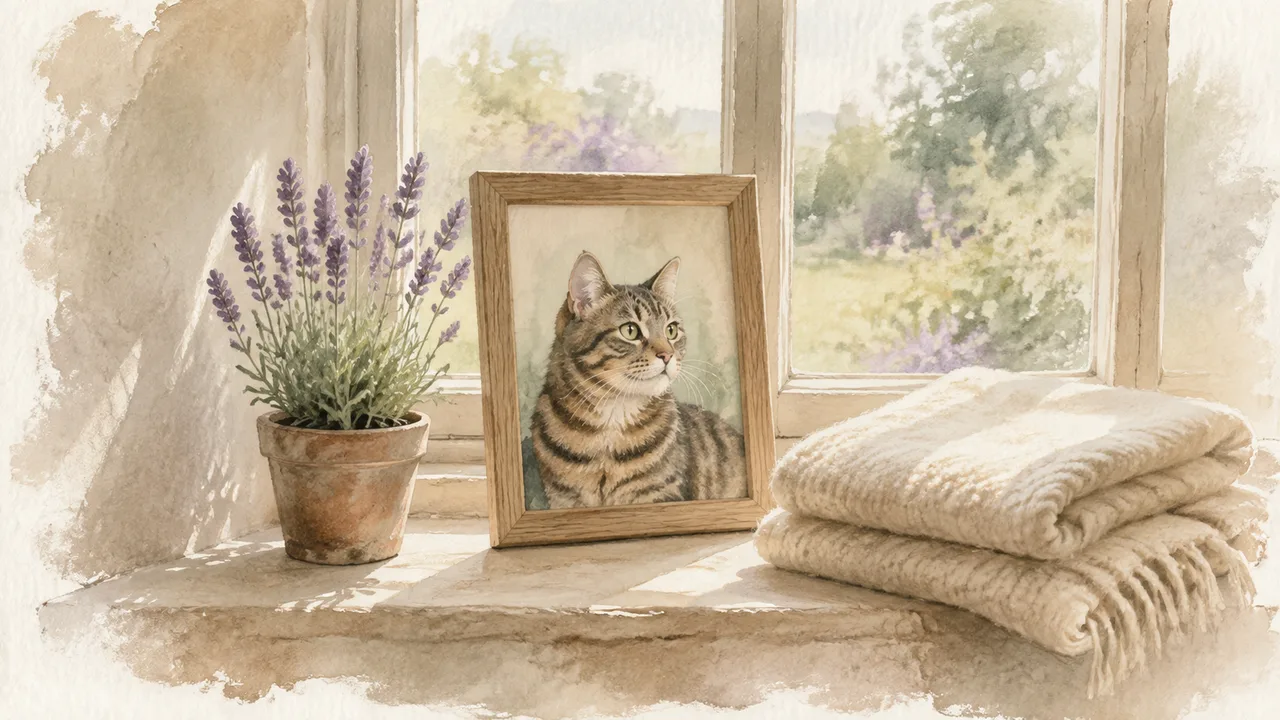
A dog memorial garden gives grief somewhere specific to go. Not a shelf in the house, not a page online: a patch of actual ground where you can sit, or plant something, or simply stand for a moment. Creating a pet memorial garden doesn't require a large space or a formal design: a single rose, a well-placed stone, or a corner set aside for garden remembrance can be enough. This guide covers the full range of outdoor memorial options: what each involves, what it costs, and what makes it work or not work in practice.
Planting a rose in their memory
A climbing rose planted against a fence or wall becomes a reliable annual marker. It flowers. It returns. It ages alongside the garden, gets bigger over the years, and gives you something to tend in the way that caring for a dog was a daily act of attention.
Older English rose varieties hold their scent better than most modern hybrids, and names matter: David Austin roses have cultivars with names like 'Gentle Hermione', 'The Lark Ascending', 'Olivia Rose'. Some families choose the variety for its name alone. Others go by colour: a deep red for a bold dog, a pale blush for a gentle one.
A bare-root rose planted in autumn or early spring is the cheaper route, and a container-grown one, available year-round, costs more. Roses are not low-maintenance (they need feeding, pruning, watching for blackspot) but that maintenance is, for many people, part of what makes them feel right as a memorial.
Planting a tree
If you have the space, a tree does something a stone or a rose can't. It grows. It gives shade in the summer heat. It holds a physical shape in the landscape that grows over the years alongside the gap they left. A rowan, a silver birch, a crab apple: any of these works for a domestic garden. A native oak needs a large garden or a woodland.
The Woodland Trust sells native British saplings by post, typically for a few pounds each, and will also plant a tree in a named memorial woodland if you don't have garden space.
One consideration worth thinking through: a tree stays when you move. Some families plant a tree knowing they might leave the property, and they're at peace with that: the tree remains, the memory goes with them. Others find that uncomfortable. If it bothers you, a rose in a large container moves with you. A tree, once established, does not.
Burying a dog's ashes at the base of a new tree when you plant it gives the whole thing a coherence. The tree is planted for them, in the most literal sense.
A memorial stone or garden plaque
A stone with a name and dates is the most direct way of marking a specific place in the garden as theirs. Most are made from slate: durable, weatherproof, engraved cleanly. Cost tracks the size of the stone and the length of the inscription, and small engravers rarely publish a list, so ask two of them. What matters more than the price is placement: a stone put where the dog actually spent time (their sunny patch, their corner, beside the back door) carries more weight than a tidily placed stone in a bed they never used.
We don't sell the stones ourselves. Our page on the dog remembrance stone looks at what a garden stone can hold and what it can't, and pairs it with the piece we do make at Small Goodbyes: a painted canvas portrait of your dog, from your photo, for the wall inside. For a wider look at materials and styles, the guide to pet grave markers covers the full range of engraved slate, stone plaques, and kerb sets.
A garden bench
A bench in the garden has an obvious practical function (somewhere to sit) and as a memorial that practicality is part of the point. You sit where they sat with you. You look at the garden from the spot they always wanted to be in.
A simple hardwood garden bench holds up well with annual oiling, and the cost depends entirely on the timber. Some suppliers offer engraved plaques for the backrest, a name, dates, a short line.
Marking their favourite spot
Dogs are specific about the garden in ways that, once you notice them, are very particular. The sunny corner in the afternoon. The patch of earth near the fence they always dug at. The spot by the back step where they waited. Marking that spot directly (with a stone, a small planted bed, a ground-level plaque) honours that specificity in a way a generic placement doesn't.
A wildflower patch
A wildflower patch is one of the lower-maintenance options and one of the most visually generous. A packet of native British wildflower seed (cornflower, ox-eye daisy, red campion, poppies) costs a few pounds and will self-seed across a prepared patch of bare soil for years with very little intervention.
A packet of British native seed mix from any garden centre will do it, and the Royal Horticultural Society publishes free guidance on creating and preparing a wildflower patch properly.
Scattering or burying ashes under a plant
You can scatter ashes in your own garden without restriction under UK law. Many families do this at the base of a plant they're planting at the same time: a rose, a tree, a lavender bush.
If you're burying the whole urn rather than scattering, make it deep enough to deter foxes: at least half a metre, many recommend more. Use a biodegradable urn if you can.
A bird bath
A bird bath doesn't read as an obvious memorial, which is part of what recommends it, and any garden centre has them. Stone lasts longer than resin outdoors and is heavy enough that nothing knocks it over.
Their collar or lead, kept in the garden
It's not unusual to hang a collar or lead in the garden: on a hook near the back gate, on a nail in the fence, on the post of a pergola. It's where the lead always went when they came back in. It stays where it went.
Lighting the space
A small lantern or solar stake light placed in the memorial part of the garden gives it a visible presence at night. It doesn't need to be a permanent fixture: a candle lantern on the anniversary can do the job once a year rather than every night.
Combining more than one idea
Most meaningful garden memorials combine two or three things. A rose planted at the base of a memorial stone, with a bench nearby to sit on. A wildflower patch with a flat stone set flush into one edge. The combination matters less than the intention.
What the garden memorial sits alongside
A garden memorial occupies different ground from the things inside the house. The stone lives outside. A portrait on the wall lives inside. Neither replaces the other. If you want something for the wall alongside the garden, we make a painted-style portrait from your own photograph: the indoor counterpart to a garden stone. The rest of these decisions are in the remembering stage.
For wider context, the guide to pet memorial ideas covers the full range, indoors and out.
Written by Craig Fearn, Small Goodbyes. Last updated .