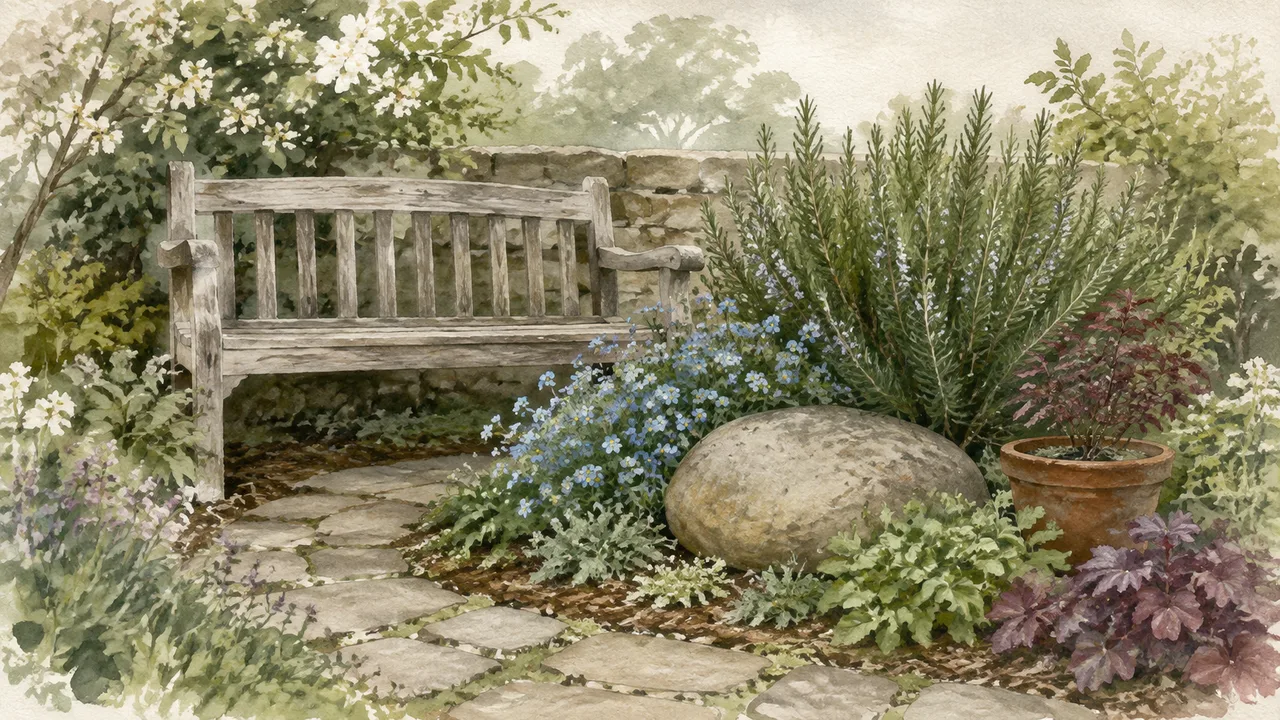
A garden stone is one of the first things people think of. You want something you can point to. A fixed place in the garden where your dog used to run, or lie in the sun, or wait by the gate. That impulse makes complete sense. A stone says: this ground meant something. This is where they were.
But a stone can only say so much. It holds the name. A date, if you want one. Perhaps a short line. What it can't hold is the particular thing your dog was: the specific tilt of their head when you said the word "walk", the precise weight of them dropping against your leg on the sofa, the way they knew when you were about to cry before you did. Those things live somewhere else, or they risk getting lost.
What a garden stone does, and what it doesn't
A remembrance stone is an outdoor marker. It belongs to a place. It weathers. It's right for gardens, for the spot under the apple tree, for the corner of a lawn where they used to disengage from the rest of the walk and find their patch of sun.
It's not wrong. It's just one kind of remembrance: the kind that marks a location. It doesn't answer the harder question, which is: how do you keep the dog themselves somewhere accessible? Not the fact that they lived and died, but who they were while they were alive.
That's the indoor piece. The one that goes on a wall, or sits on a shelf, or gets shared with a family member who lives three counties away and never got to see the garden.
A painted portrait holds a face
The canvas is stretched over a 2cm FSC-certified wood frame and rendered in a painted style from the photograph you send us. Not a filtered print: a painting-style likeness in warm earth tones, the kind that reads as art rather than photo-enlargement. The broad head of a Labrador, the quizzical expression of a Collie, the particular proud set of a Staffordshire Bull Terrier's ears: the style holds across breeds because it works from the actual photograph rather than a template.
A portrait on the kitchen wall means the dog is still somewhere in the room. You don't have to go outside, in the rain, in November, to remember them. They're there. In the light.
How it works alongside a garden stone
These two things don't compete. A lot of families do both. The stone is the garden marker: it belongs to the garden, to the seasons, to the physical place where your dog lived. The portrait is the house piece: it belongs to the rooms where you still are, where the dog's absence is most present.
A few families place the order for a canvas portrait at the same time they commission a stone, thinking of them as two halves of the same thing. The outdoor acknowledgement and the indoor one. Both say: this dog was real, their life was worth marking.
If you're also interested in a canvas portrait on its own, that page covers where it is printed and how, and every size is listed on the formats page.
For any breed, any story
We've made memorials for old dogs at the end of long lives, for young dogs lost too early, for rescue dogs whose full histories no one completely knew. Any breed. Any mix. The canvas works from whatever photograph you send: a good phone photo is enough, so long as the dog's face is clear and the lighting isn't harsh.
Delivery
Made to order and posted to UK addresses in about four to nine working days. Delivery is included, and we deliver within the UK only.
One honest note about how we make it
Every portrait is drafted with AI tools, and you see it on screen and accept it before you pay. If the dog in front of you is not the one you knew, you do not accept it: nothing is printed and nothing is charged.
Related: pet grave markers, where the canvas is printed, dog memorial garden ideas, and the rest of the remembering stage.