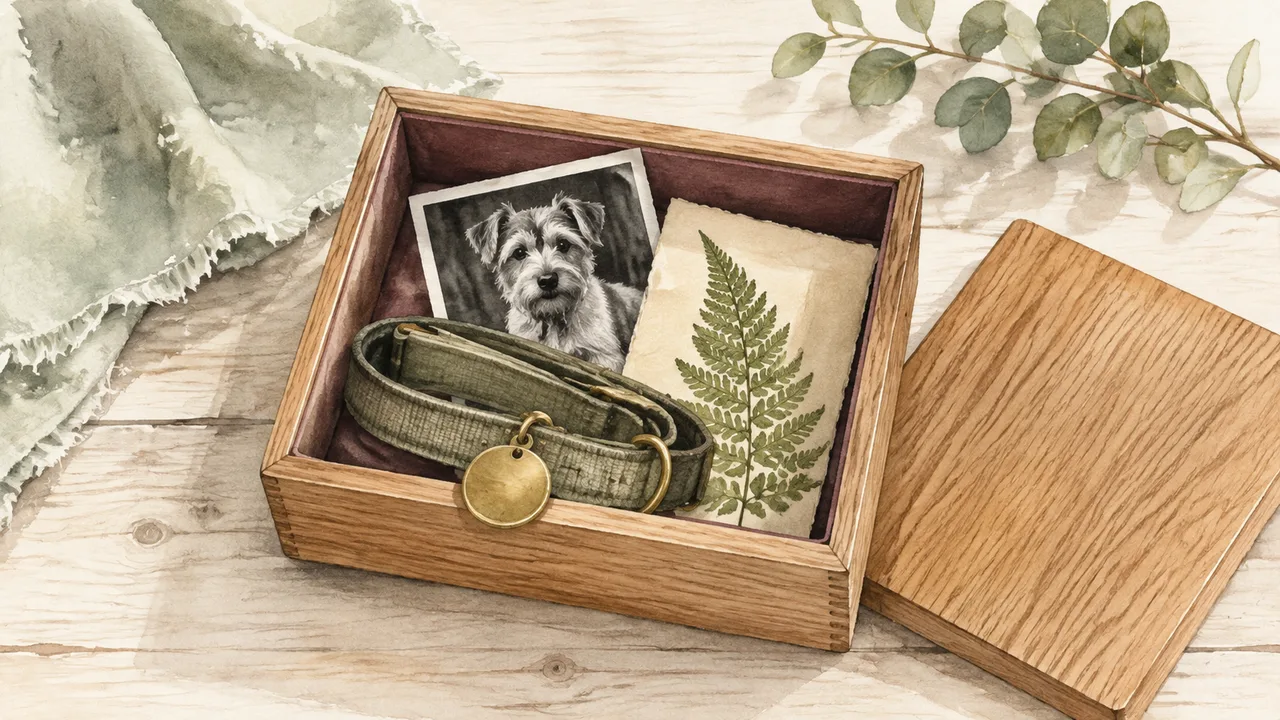
Cat memorial ideas work differently from dog memorial ideas, because cats inhabit a house differently from dogs. They claim specific spots. They organise the domestic day around warmth and light and preferred angles. Losing a cat means losing a presence that was woven into particular corners of the house. The ideas that work best tend to be the ones that acknowledge that specificity, not generic pet-loss gestures, but something tied to where this cat actually was.
The sunny windowsill
Most cat owners have a windowsill, a chair, or a specific shelf that was indisputably the cat's. They returned to it every afternoon. They knew when the light would hit it. They arranged themselves on it in a way that made clear it wasn't available for other purposes.
That spot is the most natural place for a memorial. A small framed photograph on the windowsill, set in the exact place they always sat, is one of the quietest and most specific things you can do. You're not putting a photograph somewhere tidy and appropriate. You're putting it in the place they used, which is different in quality.
A cat memorial frame gives the photograph a considered home rather than a clip-frame improvisation. The frame is there every time the light hits the windowsill at the angle it used to hit them. That daily encounter is part of what makes a memorial a memorial rather than just a decoration.
Keeping the favourite blanket
This is one of the simplest and most honest things you can do. The blanket they always chose (the worn fleece, the corner of the sofa throw, the folded towel in the laundry room): keep it where it was. Don't fold it away immediately. The scent stays for a while.
Some families keep the blanket for months. Others eventually fold it and put it somewhere reachable rather than on display, which is a different kind of keeping. There's no rule about how long it should stay. The blanket doesn't need to be explained or justified to anyone.
A cat's chosen objects carry a specific texture of memory that no photograph does. The way the blanket is slightly felted from years of kneading. The particular depression in the cushion. These are physical facts about who they were, and keeping them is not sentimental excess: it's a reasonable response to a real thing.
A portrait in their place
A painted-style portrait hung where the cat spent the most time does something different from a photograph. A photograph shows what they looked like. A portrait, done well, tries to show who they were: the set of the face, the character behind the coat.
Cats are difficult to photograph in ways that capture them accurately. They're either too still (asleep, not themselves) or too fast. A portrait made from a photograph can take a candid phone image and render it in a way that feels considered and specific. The brushwork slows you down. You look at it differently.
We make cat portrait paintings at Small Goodbyes from photographs you send us. Any coat pattern, any age. The canvas arrives in around a week and can be hung as it comes or framed. The memorial frame page shows the framed version. A portrait doesn't have to be large. A 30 × 40cm canvas on the wall of the room they lived in most is exactly the right scale.
Memorials for an indoor-only cat
An indoor cat never claimed a garden spot. Their whole world was the house, and that's where the memorial belongs. The windowsill they always chose. The top of the bookcase. The exact chair. A small shelf at the height they preferred to be at. Cats have opinions about elevation, and many prefer to be above rather than below.
You can create a small memorial shelf: the portrait or photograph, a candle, perhaps the collar, perhaps the favourite toy. Not a shrine: a quiet shelf, set apart. It can be visible to visitors or in a more private room; either is fine. The point is that it's a place, not just an object scattered among other things.
Indoor-cat owners sometimes feel they can't use garden-based memorial options, but there's one that works regardless: a small potted plant or marker placed outside a window the cat looked out from. The cat never went outside, but they watched that garden. A pot of lavender or a small planted herb on the windowsill, tended in their memory, is a real memorial even without garden access.
A small garden marker
Even for a cat who never went outdoors, a small garden marker makes sense. Place it below a window they always looked out from, beside a door they sat by, near the edge of the patio they watched from the glass. It doesn't have to mark a burial site to be meaningful.
For outdoor cats, the garden marker is often placed in a spot they returned to: the patch of earth they liked to sit in, the corner behind the shed, the south-facing bed they always found. That specificity matters. A stone placed where they actually were carries more weight than one placed tidily near a flower bed they never visited.
Engraved slate cat memorial stones are the common choice, and some suppliers offer an etched silhouette alongside the inscription. Weatherproof, low-maintenance, and they hold up through UK winters without much attention. We have not printed a price here because the ones we found quoted online were nobody's published figure.
The bowl and the spot where it was
The bowl goes somewhere specific every day. The feeding spot (corner of the kitchen, edge of the utility room, the mat by the back door) is one of the most routine places the cat occupied. It's also one of the most disorienting absences. You walk past it at the same time every morning.
Some families keep the bowl and the mat in place for a while. Others can't bear to. Both responses are honest. If you keep it, a small candle nearby on the day they died, or on the anniversary, is a quiet way to mark the place as having meaning rather than just being empty.
A written record of who they were
The specific things about a cat (the particular meow used for different requests, the way they chose one person over another for sleeping proximity, the inexplicable habit that made no sense and made complete sense) are the things most at risk of being lost. They're not recorded anywhere. They live in the memory of the household, and memories thin over time.
Writing them down, even informally, is worth doing sooner rather than later. The specific details are most vivid in the first weeks. A written record doesn't have to be for anyone else to read: it can be a private note of who the cat was in your household, the kind of document that will matter in ten years when the sharpness of the memory has softened.
A tribute page to share with people who knew them
Cats are known, specifically, by a small number of people: the household, a few visitors who knew them over years, the vet, perhaps a neighbour who fed them occasionally. A private page (photographs, a written note, the dates) is something you can share with exactly those people without explaining yourself to the wider world. It's also a record you'll be glad exists in five years; physical things can be lost or damaged.
A charity donation
A donation to Cats Protection, Battersea Dogs and Cats Home, or the Blue Cross in a cat's name is an option that suits some personalities well: people who are uncomfortable with objects, or who find an outward-facing action more useful than a private one. This is also a sensible thing to suggest to friends or family who want to do something. A donation in lieu of flowers is a specific, useful thing for someone to offer when they don't know what to say.
Sitting in their spot
This one doesn't require anything to be bought or made. Sit in the chair they always chose, or by the windowsill, at the time of day they would have been there. Five minutes. You don't have to do it every day. But on the difficult days (the first week, the anniversary, the unexpected moment when the light is at exactly that angle) it's something to do that isn't nothing.
Grief for a cat is the quiet kind, mostly. It arrives in the margins of the day rather than in full scenes. The memorials that suit it tend to be the same: small, specific, worked into the corners of ordinary life rather than set apart from it.
Combining a few things
Most families end up with more than one thing. A portrait on the windowsill and the blanket folded nearby. A garden marker outside the window and a candle on the anniversary. These aren't competing options; they're different registers of the same loss, and each one serves a slightly different moment.
Start with whatever feels most urgent. If you want something on the wall quickly, the portrait is the fastest to arrange. If you want something outside, a small plant or marker can be put in place this weekend. None of it needs to be done all at once.
For the full range of memorial options including things suitable for any pet, the pet memorial ideas guide covers them honestly and without selling a specific one.
Written by Craig Fearn, Small Goodbyes. Last updated .